The American full-size pickup truck market is fiercely competitive, dominated by long-standing domestic titans. Yet, for over two decades, Toyota’s Tundra has carved out a significant, loyal following. It's a testament to its unwavering commitment to reliability, formidable V-8 power (in its earlier forms), and an SUV-like package tailored specifically for U.S. drivers. To truly appreciate this achievement, we need to trace the remarkable Design Evolution and Interior Features of Tundra Generations, revealing how this formidable truck adapted, innovated, and solidified its place in the pickup pantheon.
This isn't just a chronology of specs; it's a deep dive into how Toyota learned, iterated, and ultimately defined what a modern, American-made truck could be, inside and out. From its ambitious beginnings to its groundbreaking third generation, the Tundra's story is one of calculated growth and bold transformation.
At a Glance: Tundra's Journey Through Generations
- Pre-Tundra Era: Toyota’s challenging entry with the T100, hampered by import taxes and underpowered V-6s, ultimately paved the way for the Tundra.
- First Generation (1999–2006): Smaller than competitors but robust, establishing Toyota's full-size presence with a reliable V-8 and an SUV-like interior feel. First full-size pickup by a Japanese automaker built in North America.
- Second Generation (2007–2021): A massive leap in size and power, moving to Texas production, offering true competitive scale, a potent 5.7L V-8 (with an optional supercharger!), and more refined interior space. Longest-running generation.
- Third Generation (2022–Now): A complete reimagining, ditching the V-8 for twin-turbo V-6s (including a hybrid option), introducing a coil-spring rear suspension, and boasting a technologically advanced, comfort-focused interior with a massive infotainment screen.
- Interior Evolution: A clear progression from basic functionality to spacious comfort, and finally to a tech-laden command center designed for the modern driver.
The Unsung Predecessor: Before the Tundra Roared
Before the Tundra earned its stripes, Toyota had to learn some hard lessons. The path to a successful full-size American pickup was fraught with unique challenges, including import tariffs and deeply ingrained brand loyalties.
Toyota's Early Foray: The T100's Challenge
Back in 1992, Toyota dipped its toes into the full-size segment with the T100, developed by its Hino subsidiary. It was a valiant effort, but fate—and economics—were not on its side. Built in Tokyo, the T100 was slapped with a 25 percent U.S. import tax, instantly making it pricier than a domestic V-8 Ford F-150. Its initial 150-hp V-6 engine, while reliable, simply couldn't compete with the raw power buyers expected from a full-size truck.
An upgrade in 1995 boosted the V-6 to 190 hp with 40 lb-ft more torque, but it remained an uphill battle. Toyota understood that to genuinely compete, they needed a truck for America, built in America, and packing the punch Americans demanded.
Paving the Way: The T150 Concept and V-8 Ambition
The lessons from the T100 weren't lost. By 1998, Toyota showcased the T150 concept – a larger, more assertively styled truck that signaled Toyota’s serious intention to enter the V-8-powered full-size market. This concept was a direct answer to years of feedback, showing a commitment to matching the domestic offerings on their own turf. The name "T150" itself hinted at its target competition, even sparking a playful—or not-so-playful—dispute with Ford over their iconic F-150. This ultimately led to a name change, giving birth to the legend we know today.
First Generation (1999–2006): Establishing the Foothold
The turn of the millennium marked a pivotal moment. The Tundra officially arrived, not just as a new model, but as a statement of intent.
Birth of a Legend: North American Roots
The first Toyota Tundra made its grand debut at the 1998 Indiana State Fair, a fitting location given its production site. This wasn't just another imported truck; it was produced at the Toyota Motor Manufacturing plant in Princeton, Indiana, making it the first full-size pickup built in North America by a Japanese automaker. This was a crucial strategic move, circumventing import taxes and demonstrating Toyota’s deep investment in the U.S. market.
Exterior Identity: Compact Power and Special Editions
From a design perspective, the first-generation Tundra was somewhat conservative, yet distinctly Toyota. Dimensionally, it was still smaller than its full-size domestic rivals, like the 10th-generation Ford F-150. This gave it a more manageable footprint, appealing to buyers who wanted full-size capability without the behemoth proportions.
Toyota experimented with variety, too. In 2003, a unique Stepside option was introduced for AccessCab models, offering a sportier look and an alternative way to access the bed. This was a nod to buyers seeking a blend of utility and distinctive styling. Perhaps the most memorable special edition was the Tundra T3, linked to "Terminator 3: Rise of the Machines." Limited to just 850 models for SR5 Access Cab rear-drive V-8s, it underscored Toyota's willingness to tap into pop culture and offer exclusive packages.
Interior Philosophy: SUV-like Practicality and Emerging Comfort
The first-generation Tundra’s interior embodied Toyota’s philosophy of reliability and practical comfort. While it might appear spartan by today’s standards, it was thoughtfully designed. The ground truth mentions an "SUV-like package," which was a significant differentiator. This meant a cabin that, for its time, was more refined and comfortable than many work-focused trucks, prioritizing ergonomics and ease of use.
You’d find durable materials, straightforward controls, and a layout that felt familiar and intuitive to anyone who had driven a Toyota SUV. Seating was comfortable for its class, and storage solutions were ample, reflecting a design ethos focused on making daily life easier for truck owners. While not luxurious, it was a dependable, comfortable space for both work and family duties, setting a precedent for the Tundra's interior evolution.
Under the Hood: From V-6 to V-8 Powerhouse
Power was a critical aspect of the Tundra's acceptance. It launched with a 190-hp 3.4-liter V-6 as its base engine, but the real star was the optional 245-hp 4.7-liter V-8. This V-8 marked Toyota's serious entry into the full-size segment, proving it could deliver the grunt truck buyers expected.
By 2005, Toyota further upped the ante. The base V-6 grew to a 4.0-liter unit, producing a more respectable 236 hp. The popular 4.7-liter V-8 also received a significant boost to 282 hp, thanks to the addition of Variable Valve Timing with intelligence (VVTi-i). Notably, no V-8 Tundra was ever sold with a manual transmission, signaling Toyota’s focus on automatic convenience for the American market.
The Tundra’s V-8 prowess even extended to the racetrack. In 2004, Toyota Racing Development (TRD) entered a 650-hp V-8 Tundra into the NASCAR Craftsman Truck Series. This made Toyota the first and only Japanese automaker to compete at that level, and Toyota teams went on to dominate, winning the series multiple times between 2006 and 2017.
Second Generation (2007–2021): The Era of American Scale and Power
The second generation represented a seismic shift for the Tundra. It shed its "smaller full-size" label and went head-to-head with domestic giants, embodying an "everything's bigger in Texas" philosophy.
Growing Up: A Tundra Built for Texas and Beyond
For the 2007 model year, the Tundra truly came of age. Production shifted to San Antonio, Texas, solidifying its American roots. The truck significantly increased in size, often measuring up to 10 inches longer overall than its predecessor. This wasn't just cosmetic; it allowed for more cargo, more passenger space, and a more commanding road presence.
Exterior Redesign: More Configurations, More Presence
The design language of the second generation was bold and aggressive, moving away from the first generation's relatively understated lines. You could choose from an impressive six body and bed configurations, catering to a wider range of needs and preferences. The AccessCab, known for its rear-hinged suicide doors, was replaced by a more conventional Double Cab featuring front-hinged doors, enhancing usability and safety. This Tundra looked, felt, and drove like a serious contender, designed to intimidate and impress.
Inside the Cabin: Expanding Space, Elevating Features
With the massive increase in exterior dimensions came a vastly improved interior. The second-generation Tundra’s cabin was simply more of everything: more space, more comfort, and more thoughtful features. The focus was on creating a highly functional yet comfortable environment that could serve as both a mobile office and a family hauler.
Expect a robust dashboard design, larger controls that are easy to operate even with gloves on, and an emphasis on storage compartments. While early models in this generation might still feel a bit utilitarian, later refreshes, particularly the significant 2014 update, brought substantial advancements. This included a redesigned interior that introduced higher-quality materials, better ergonomics, and more sophisticated infotainment options, truly elevating the user experience. The available CrewMax variant, with its expansive rear legroom, became a particular favorite for families and those needing ample cabin space.
The Power Play: Dominant V-8s and the Supercharger Option
Under the hood, the second-gen Tundra continued its V-8 dominance. While a 236-hp 4.0-liter V-6 was still offered initially, the stars were the V-8s: a 276-hp 4.7-liter and, most notably, a powerful 381-hp 5.7-liter V-8. The 5.7-liter was paired exclusively with a new six-speed automatic transmission, a significant upgrade that improved both performance and efficiency. Manual transmission Tundras were officially retired, signaling the industry's shift.
For enthusiasts seeking even more grunt, Toyota Racing Development (TRD) offered a bolt-on Eaton Roots-type supercharger for the 5.7-liter V-8. For $5875, it boosted power from 381 hp to a staggering 504 hp and torque from 401 lb-ft to 550 lb-ft. This transformed the Tundra into a genuine performance truck, further highlighted by special editions like the Ivan "Ironman" Stewart Signature Series Tundra, which came with the TRD-supercharged V-8 and Hella lamps.
Towing Feats and Facelifts: Endurance and Refinement
The second generation proved its mettle in spectacular fashion. You might recall the viral moment in 2012 when a Tundra CrewMax (381-hp 5.7-liter V-8, 4WD) famously towed the Space Shuttle Endeavour. This wasn't just a publicity stunt; it demonstrated the Tundra's raw power and engineering integrity, moving the 292,500-pound shuttle and its transporter for five minutes across the Manchester Bridge.
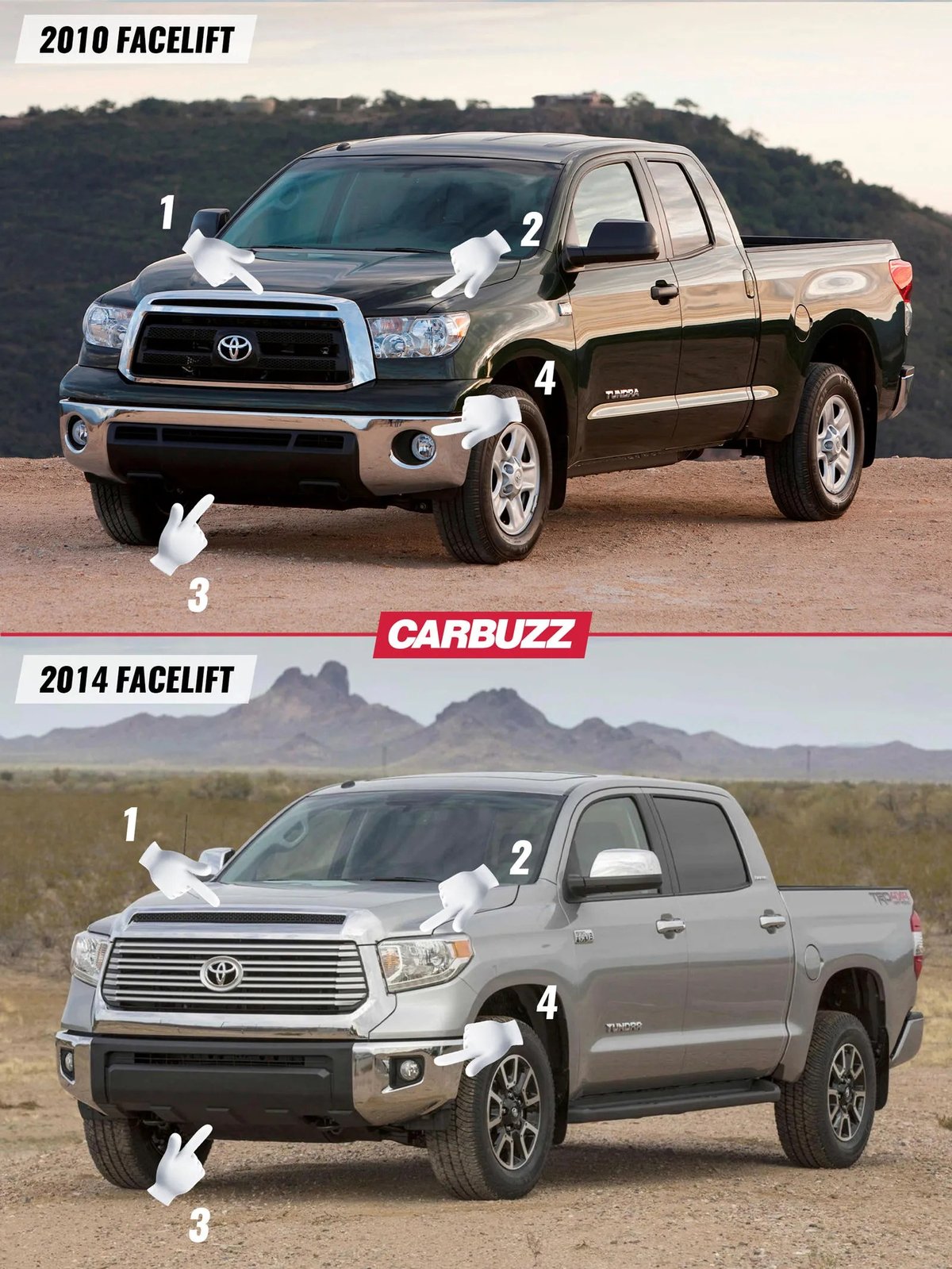
This generation had a long run, undergoing several key facelifts. The 2010 model year introduced a mild facelift and equipment upgrades, replacing the 4.7L V8 with a more powerful 4.6L unit. However, the most significant transformation came with the 2014 refresh. This brought a substantially larger grille, chiseled fenders, new taillights, and, crucially, a redesigned interior. The base 4.0-liter V-6 also gained 34 hp, reaching 270 hp. The 2014 interior refresh moved the Tundra forward significantly in terms of material quality, layout, and available technology, better competing with evolving domestic cabins.
Toyota also continued its off-road racing legacy. In 2014, a Toyota Tundra TRD Pro finished first in its class at the Tecate SCORE Baja 1000, conquering over 1200 miles in 35 hours and 40 minutes, showcasing its rugged durability. For its final three model years (2019-2021), the XK50 Tundra streamlined its engine offerings, available only with the 4.6L and 5.7L V8 engines, losing the V6 option. If you're looking for an overview of the journey, you can Explore Tundra Generations in more detail.
Third Generation (2022–Now): Redefining Modern Full-Size
The arrival of the third-generation Tundra for the 2022 model year was less an evolution and more a revolution. Toyota fundamentally rethought nearly every aspect, from powertrain to suspension to interior design, aiming squarely at the future of the pickup truck.
A Bold New Chapter: Turbocharged Power and Hybrid Innovation
The biggest news under the hood was the complete departure from the long-standing V-8s. The 5.7-liter V-8 was replaced by a more efficient yet incredibly powerful 389-hp twin-turbo V-6, churning out an impressive 479 lb-ft of torque. But the real game-changer was the optional i-FORCE MAX hybrid powertrain, combining the twin-turbo V-6 with an electric motor to deliver a staggering 437 hp and 583 lb-ft of torque. Both new engines are paired with a smooth and responsive 10-speed automatic transmission, optimizing power delivery and fuel economy.
Exterior Modernity: Purpose-Driven Aesthetics
The exterior design of the third-gen Tundra is unmistakably modern and aggressive. It features a massive grille (often color-matched or blacked out depending on trim), sharp lines, and sculpted fenders that project a strong, contemporary presence. It maintains a distinct Tundra identity while looking entirely fresh, designed to stand out in a crowded segment.
Interior Revolution: Tech, Comfort, and Command Center
The interior of the third-generation Tundra represents its most dramatic transformation. This isn't just an update; it's a complete reimagining of the cabin experience. Gone are the slightly dated aesthetics of previous generations, replaced by a sophisticated, tech-forward, and remarkably comfortable environment.
The centerpiece is undoubtedly the optional 14.0-inch infotainment system, the largest available in a pickup at launch. This horizontally oriented touchscreen dominates the dashboard, offering crisp graphics, intuitive navigation, and seamless integration with Apple CarPlay and Android Auto. Below it, physical buttons and knobs for climate control and essential functions remain, a thoughtful nod to usability while driving.
Materials are significantly upgraded across the board, with soft-touch surfaces, contrasting stitching, and premium finishes in higher trims. The layout is driver-centric, with a clear focus on ergonomics and ease of access to controls. Digital instrumentation is available, providing customizable displays for vital vehicle information. The rear passenger space is generous, especially in CrewMax models, and storage solutions are clever and abundant. The third-gen Tundra’s interior truly feels like a modern command center, blending rugged capability with high-tech luxury.
Advanced Suspension: Beyond Leaf Springs
Further enhancing the drive and comfort, the third generation completely overhauled its rear suspension. The traditional leaf springs, a truck staple for decades, were replaced by a more sophisticated coil-spring multilink design. This change dramatically improves ride quality, handling, and stability, especially when unladen. For those seeking ultimate comfort and adaptability, an available air-spring suspension with electronically controlled dampers takes ride refinement to another level, automatically adjusting to varying loads and road conditions. This new Tundra can also tow an impressive 12,000 pounds, proving its capability hasn't been sacrificed for comfort.
Across the Generations: A Deep Dive into Interior Design Philosophies
Looking at the Tundra’s interior evolution reveals a clear trajectory: from rugged utility to refined comfort, culminating in today’s tech-forward command center.
From Utilitarian to Ultra-Modern: Tundra's Cabin Evolution
- First Generation (1999–2006): The Functional Foundation. The interior was solid, practical, and dependable. It leaned into the "SUV-like package" concept, offering more comfort than a basic work truck but prioritizing durability and straightforward functionality. Materials were robust, controls were simple, and the overall aesthetic was understated. Technology was minimal, mostly consisting of a basic radio and climate controls.
- Second Generation (2007–2021): The Era of Spacious Comfort. With a much larger footprint, this generation expanded cabin volume significantly. The interior design became bolder, with larger buttons and a more imposing dashboard, reflecting its Americanized scale. While early models were still somewhat utilitarian, the 2014 interior refresh was a game-changer. It introduced better materials, improved fit and finish, and a more contemporary layout, including an upgraded infotainment system. This generation moved towards making the Tundra a comfortable daily driver, not just a workhorse.
- Third Generation (2022–Now): The Digital Command Center. This generation leapfrogs its predecessors, embracing cutting-edge technology and premium materials. The focus shifted to creating a highly connected, luxurious, and ergonomically advanced cabin. The giant 14-inch touchscreen isn't just a display; it's the brain of the vehicle, complemented by digital gauges and advanced driver-assistance features. Comfort is paramount, with sophisticated seating and a quieter cabin environment thanks to the new suspension and construction. It’s a space designed to compete with the most modern and upscale trucks on the market.
Key Elements of Each Generation's Interior
- Dashboards: From a simple, straightforward layout in Gen 1, to a more imposing, chunky design in Gen 2, and finally to a horizontally oriented, sleek, and tech-integrated design in Gen 3.
- Infotainment: Basic radio/CD player in Gen 1, evolving to smaller touchscreens and improved connectivity in Gen 2 (especially post-2014), and culminating in the massive, highly advanced 14-inch system in Gen 3.
- Materials: Durable plastics in Gen 1, improving to a mix of hard and soft-touch plastics in Gen 2, and significantly upgraded with premium soft-touch surfaces, stitching, and metal accents in Gen 3.
- Seating: Comfortable but basic cloth/leather in Gen 1, larger and more supportive in Gen 2, and highly ergonomic, often heated/ventilated, with advanced adjustability in Gen 3.
- Storage: Ample but conventional in Gen 1, expanding with more cubbies and larger center consoles in Gen 2, and featuring highly organized, clever solutions in Gen 3.
Common Questions About Tundra Generations
Which Tundra generation is considered the most reliable?
Toyota trucks are renowned for reliability across the board. The first and second generations are often lauded for their bulletproof V-8 engines and simpler mechanicals, making them favorites for long-term ownership. While the third generation is too new for a full long-term reliability assessment, its new powertrains and complex systems will need time to prove themselves, though Toyota’s reputation for quality remains high.
What's the biggest interior change in the Tundra's history?
Without a doubt, the jump from the second generation to the third generation marks the biggest interior overhaul. The introduction of the massive 14.0-inch infotainment screen, the shift to a fully modern and digital dashboard, and the significant upgrade in materials and design philosophy completely transform the cabin experience.
Can I still get a V-8 Tundra?
No, if you're buying a brand-new Tundra, you will not find a V-8 option. The third generation (2022–Now) has entirely moved to twin-turbo V-6 engines, including a hybrid variant. If a V-8 is a must-have for you, you'll need to look at second-generation Tundras (2007–2021), which offered the robust 4.6L and 5.7L V-8s until 2021.
Which generation offered a manual transmission?
The Toyota Tundra never offered a manual transmission with its V-8 engines. While the first generation initially had a manual option with its V-6, it was phased out early on. By the second generation, all Tundras were exclusively automatic, a trend that continues with the third generation's 10-speed automatic.
Choosing Your Tundra: What Each Generation Offers You
Each Tundra generation has a distinct personality and set of priorities, making it suitable for different buyers. Understanding these differences is key to finding the right truck for your needs.
Considering a First-Gen Tundra?
If you're looking for a relatively compact, incredibly reliable full-size truck for light-duty work, occasional towing, or a dependable daily driver that won't break the bank, the first-generation Tundra (1999–2006) is a fantastic choice. Its smaller dimensions make it easier to maneuver in urban environments, and its V-8 is known for its legendary longevity. Just be prepared for a more basic interior and fewer modern amenities.
Eyeing a Second-Gen Workhorse?
For those who need serious towing and hauling capability, a powerful V-8 engine, and a comfortable, spacious cabin that can handle long hauls, the second-generation Tundra (2007–2021) is an excellent contender. Especially post-2014 facelift models offer a great balance of modern features, robust performance, and proven reliability. They offer true full-size presence and muscle without the bleeding-edge tech (and associated cost) of the latest generation.
Looking for Cutting-Edge in the Third-Gen?
If you prioritize advanced technology, superior ride comfort (thanks to the new suspension), impressive fuel efficiency (especially the hybrid), and a powerful, modern powertrain, then the third-generation Tundra (2022–Now) is your truck. Its interior is a significant leap forward, offering a premium experience with a huge infotainment screen and sophisticated driver aids. This is the Tundra for buyers who want all the latest innovations in a full-size pickup.
The Tundra's Legacy: A Commitment to the American Truck Market
From the initial struggles of the T100 to the bold innovation of the third-generation Tundra, Toyota has continuously evolved its full-size pickup, always with the American buyer in mind. The design evolution and interior features of Tundra generations tell a story of careful listening, strategic investment, and a relentless pursuit of improvement.
Whether you're drawn to the rugged simplicity of an early model, the brute force of a second-generation V-8, or the sophisticated power of the latest hybrid, the Tundra lineage offers a compelling choice for any truck enthusiast. It’s a testament to how a challenger brand not only survived but thrived in one of the toughest automotive segments, proving that reliability, capability, and a thoughtful design approach can indeed secure a lasting legacy.